
Law Enforcement and Children: Community Helpers or Adversaries?
By Diane Whitehead, President & CEO
A couple years ago, I wrote a short blog titled Our Children Are Watching Us and indeed they still are. The recent increase in war and conflict just shows us how far away we are from understanding how to bring peace to our world and protect our children.
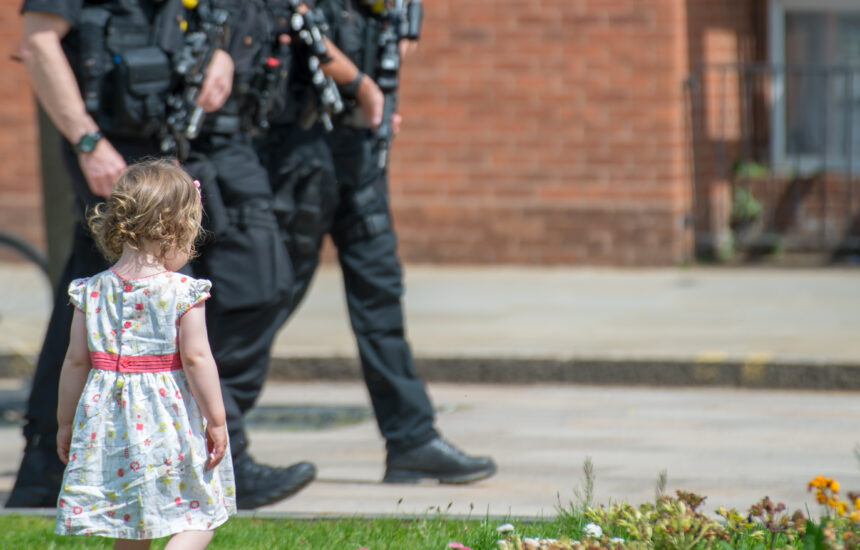
But communities the world over are also seeing unacceptable increases in aggressive acts by police and security forces in their own neighborhoods — acts not considered part of a declared conflict or war but taken under the guise of community policing. This is a threat to us all and also particularly confusing for children as they most often view police and security personnel as their protectors. In many preschools, police are included in lessons as “community helpers” and children are told by teachers and parents that if they need help, feel unsafe, or are in danger that police officers are there to help them.
In recent months, of course, the increased presence of immigration security forces in the U.S. has meant that many children have witnessed aggression in their own homes as their parents are detained, and sometimes threatened or harmed in the process. Additionally, in several instances, immigration forces have entered school grounds, schools, or preschools to locate or search for teachers that they believe are in the U.S. illegally, all while children are present and watching. As we have seen in news footage, these forces carry guns and wear tactical gear that can be terrifying to children. Many of the security forces cover their faces in black masks to hide their identity which can increase fear and traumatize children.
In some reported cases, children themselves have been temporarily detained, separated from caregivers, or left in uncertain circumstances following enforcement actions — experiences that can have profound emotional and mental health consequences even when physical harm is not intended. Studies have well established that adverse childhood experiences, where children are exposed to violence and abuse, contribute to devastating health outcomes such as emotional and cognitive impairment, adoption of high-risk behaviors, and even premature death.
Whatever the reason may be for these searches, which the U.S. public and politicians continue to debate, we must ensure that all police and official security personnel who are interacting with families are trained in how to conduct themselves when children are present.
The U.S., however, is hardly alone in this regard. Information regarding security forces harming children in South Africa spans from historical abuses during the apartheid era to contemporary reports of police brutality, sexual exploitation by peacekeepers, and the indirect impact of military deployments in gang-ridden areas.
There are ongoing reports of police brutality in South Africa, with the Independent Police Investigative Directorate (IPID) documenting a lack of accountability for thousands of complaints annually. Reports indicate that children are often the victims of violence or abuse during law enforcement actions, with instances of torture and physical abuse by police recorded.
Human rights reports and UN sources have also historically raised concerns about harm to children by security forces in India. In 2023, India was removed from the UN Secretary-General’s annual report on children and armed conflict, acknowledging the government’s efforts to improve child protection. While removed from the report, the UN continues to encourage India to train security forces in child protection, prevent the use of pellet guns, and ensure children are protected from detention.
Similar misconduct involving children have been reported worldwide. From Nepal to Australia, Germany to China, Russia to Indonesia, we can find examples where children have been unnecessarily exposed to violent police actions and have also, very regrettably, even been detained by law enforcement.
We must recognize that these experiences do not occur in isolation. The stress, fear, and instability created within families can deeply affect parents and guardians, who are then tasked with supporting children through trauma while managing their own emotional responses. This stress often follows children into early learning environments and classrooms, where teachers and caregivers must help children make sense of frightening events unfolding at home or in their communities.
Many police officers actually do receive training in how to protect children during times where a situation could become forceful or aggressive and we are thankful for the many jurisdictions around the world who provide this specialized training to their officers. We should all look to examples of these training programs in our own communities and share these examples as best practices for supporting and protecting children in these challenging circumstances.
To name just a few, there are several measures that can help to ensure that children remain safe during community upheavals and disturbance, including:
It is a critical call to action that all law enforcement seriously examine how they are protecting children at times when communities are facing disruption and turmoil.
At the same time, educators and early childhood professionals must also be equipped with the knowledge and tools to respond to trauma-related stress behaviors in developmentally appropriate ways. Resources such as CE International’s short course on the Impact of Trauma can help teachers and caregivers better understand how exposure to fear and instability may manifest in young children — and how to support resilience and recovery in safe, supportive learning environments.
Remember: Our children are always watching. As child advocates we must be a constant voice in pleading for security forces in every nation— whether police or other types of security personnel — to be trained in how to conduct themselves when children are present. How do we ensure that all adults fully understand that childhood is a fragile and sensitive state of development and any aggressive or violent act they witness not only frightens them, but can leave them with lifelong scars and trauma?
As leading voices for children we must all call on security forces to immediately refrain from violence and to keep children and young people out of harm’s way. We must remind all involved in protecting children to share with law enforcement the basic premises enshrined in the Convention on the Rights of the Child (CRC), to uphold the child’s best interests.
We must join our voices to ensure that children in communities feel safe, but especially that those they look up to as community helpers and protectors do not become their greatest fear. And we must ensure that the adults who care for and educate children every day are supported in responding to the emotional realities children bring with them into homes, classrooms, and communities.
 Diane Whitehead, President & CEO
Diane Whitehead, President and CEO of Childhood International, has dedicated her career to issues that affect the lives of children and families. She specializes in global education, children’s education and learning, the human right to education, nonprofit leadership, management, strategic direction-setting, and program development.
Through her strategic guidance and management of this 130+year-old organization, Diane has expanded its global reach, built partnerships with education-focused organizations around the world, designed impactful programs, and participated in key international education forums and United Nations’ initiatives, a recognition of her commitment to transforming education. As Chief Executive Officer, she is dedicated to building CE International’s relevancy, reach, and impact.
Diane is the creator of Education Diplomacy and co-author of the Education Diplomacy Professional Standards. She also co-authored the International Principles of Practice for Educators to guide and inspire practitioners and to elevate the education profession by highlighting the incredible service that educators provide to both international and human development. Both Education Diplomacy and the International Principles of Practice are forging new pathways for the professional development of educators.
Diane is committed to the nonprofit sector and believes that civil society organizations are critical to delivering programming that supports access and quality in education and increases the resources dedicated to the education and care of children, particularly children facing extreme challenges such as war, conflict, migration, food and water insecurity, life threatening pollution, and climate change.
Diane has spent much of her career advocating for improved economic outcomes and social change that promotes equity and social justice, as she believes these are essential to creating change for children and a better world for all. Diane has said, “No one has the power keep people apart based on race, ethnicity, country of origin, religious beliefs, or gender. We must find a way to live together and help our world to seek peace and harmony.” She firmly believes that education is essential to providing individuals with more opportunities in life and creating a more stable and secure world.
“Be the change you wish to see in the world”- Mahatma Gandhi
Diane is available to speak on education topics, leadership, change management, and the future of humanity. If you would like to invite Diane for a speaker engagement at a conference or event, please contact Ashley Nelson, Director of Communications, at anelson@ceinternational1892.org.
Explore CE International's consulting services.